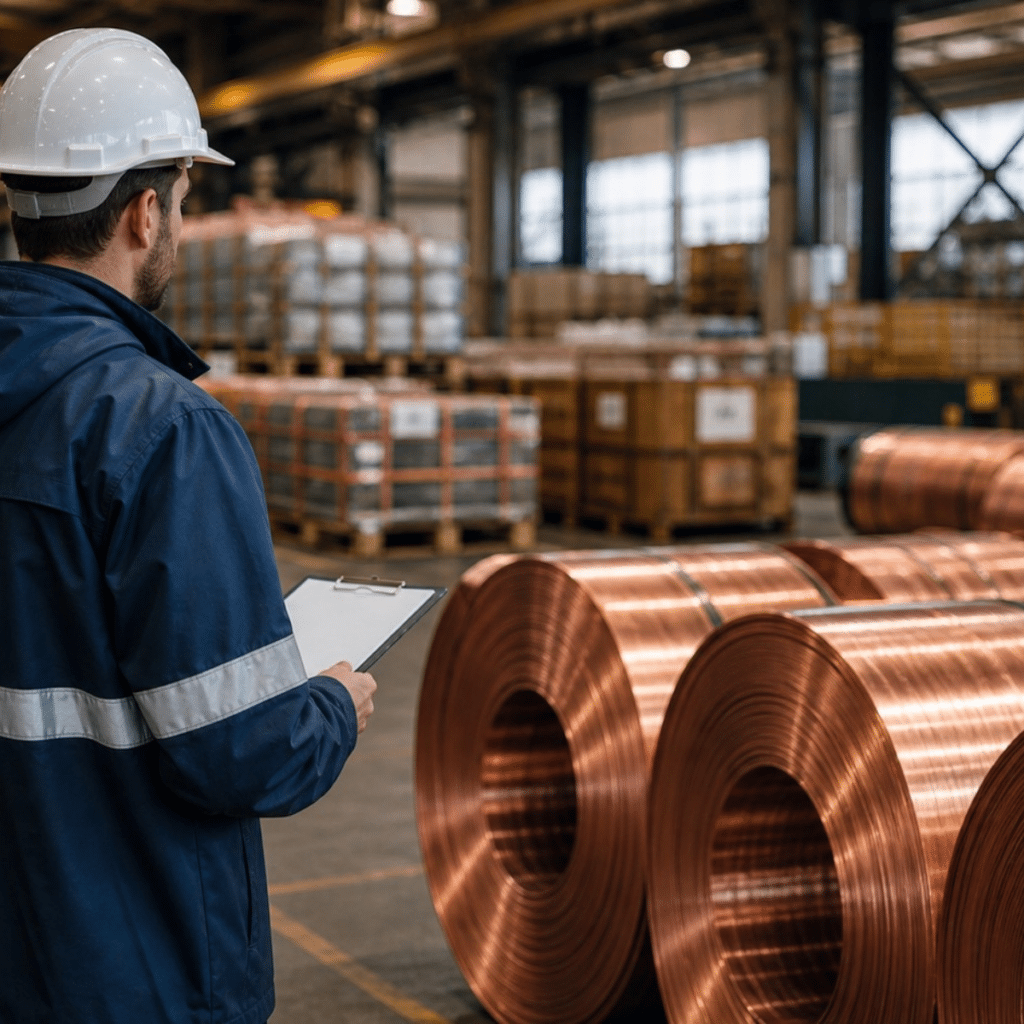
Shortages, rising costs, disruptions in logistics… Supply chain management has become a major strategic challenge for any industrial buyer. Gindre, a French specialist in copper processing for over 200 years, offers a practical approach to help you optimize your products and processes, thereby improving the reliability of your delivery times in the face of current global market pressures.
A global supply chain under intense pressure
For several years now, the global supply chain has been undergoing an unprecedented crisis. Between the health crisis, which has highlighted the fragility of just-in-time systems, wars on various continents that are disrupting access to strategic raw materials, and rising shipping costs, industrial companies are facing major disruptions on a global scale.
For industrial buyers and logistics managers, the risk of not receiving supplies on time has become a daily concern. The OTD (On-Time Delivery) metric, which measures a supplier’s ability to deliver within agreed-upon deadlines, is deteriorating across nearly all industrial sectors, putting pressure on companies’ production plans and business continuity. In this context, passively waiting for the market to normalize is no longer a viable option for organizations that wish to remain competitive.
The question, then, is no longer whether your supply chain will be disrupted, but how to prepare for it. The companies that fare best do not react in a rush; they anticipate, plan, and optimize their needs. It is precisely this approach that Gindre supports its clients with on a daily basis to provide sustainable copper solutions.
The main risks that compromise your industrial logistics
Before implementing an effective strategy, it is essential to clearly identify the sources of risk affecting your supply chain. These risks are numerous and are often interconnected.
Shortages of raw materials and components
The shortage is undoubtedly the most visible and immediate challenge. In the manufacturing industry, stockouts of certain items—particularly in the area of copper semi-finished products such as bars, coils, sheets, and machined components—directly result in unplanned production stoppages. Global demand, driven by increasing urbanization, has grown much faster than supply capacity, creating a structural imbalance that is difficult to resolve in the short term. This phenomenon is particularly pronounced in the electric mobility, energy distribution, and electrical equipment sectors, all of which are heavy consumers of copper.
Rising logistics and raw material costs
Total logistics costs have risen sharply in recent years. Rising transportation costs, increased storage expenses, inflation in raw materials, and labor pressures: for industrial buyers, managing these costs while maintaining a high level of service has become a constant balancing act. The rise in copper prices on global markets further amplifies this pressure for companies that work with semi-finished products and components made of copper and copper alloys.
Overreliance on a concentrated network of suppliers
Many companies have discovered their vulnerability by relying on too few suppliers or geographic regions. This vulnerability, long overlooked in the name of cost optimization, is now a major risk to business continuity. Supply chain risk management now requires strategic diversification of supply sources, greater resilience across the global supply chain, and enhanced collaboration with integrated industrial partners capable of responding to various market conditions.
Shipping times and logistical disruptions
Global shipping has faced major disruptions in recent years, including port congestion, container shortages, and rising freight rates. These challenges directly impact lead times and complicate supply chain management for companies that source goods internationally. Logistics has become a critical link in the industrial value chain, requiring greater attention and strategic management.
Our solution: optimize your product designs to improve your supply chain
In the face of these disruptions, the most effective response does not lie solely in urgently seeking out alternative copper suppliers. It begins much earlier: right from the design phase of electrical products. Optimizing product designs to align them with market standards and actual industrial capabilities is now an essential supply chain management strategy.
This approach helps to structurally reduce supply risk, improve service levels, control costs over the long term, and strengthen the overall resilience of the supply chain. It serves as both an economic and strategic lever, one that is often underestimated in industrial value chain management.
What does that mean in practical terms?
Optimizing product design within a resilient supply chain framework requires several concrete steps that design teams and buyers can take starting today:
- Select standardized copper sections, shapes, and alloys that are available from stock at multiple suppliers worldwide
- Avoid overly restrictive custom specifications that limit access to a single supplier and jeopardize business continuity
- Adapt technical tolerances to the actual industrial capabilities of the extrusion, drawing, and rolling processes available on the market
- Reduce the number of SKUs to simplify inventory management and logistics
- Anticipate supply needs as early as the product development phase to avoid emergencies
- Incorporate a comprehensive view of logistics and transportation constraints into technical specifications
Inventory and Flow Management: Best Practices to Adopt
An efficient supply chain also depends on rigorous day-to-day management of inventory and logistics. In a context of supply chain constraints, several best practices can help mitigate risks and sustainably improve service levels.
Set appropriate safety stock levels
In the face of disruptions and extended lead times, maintaining sufficient safety stock for critical items is essential. This approach helps absorb logistical uncertainties without disrupting production continuity. However, it must be carefully calibrated to avoid excessive storage costs and unnecessary tie-up of cash flow.
Review the just-in-time strategy
The just-in-time model has shown its limitations during recent supply chain crises. Many companies are now revising their logistics strategies to build in greater resilience, accepting higher inventory levels in exchange for greater operational security and a better ability to meet their own customers’ demand.
Manage data flows in real time
Real-time visibility into order status, supplier lead times, and inventory levels is essential for effective supply chain management. Modern supply chain management tools enable logistics managers to anticipate stockouts, manage priorities, and take action before the situation becomes critical for production.
Copper and the Challenges of the Energy Transition
Global demand for copper continues to rise. According to several international scenarios, it could grow by 30 to 50% by 2040, driven by the electrification of applications, the development of renewable energy, and the rise of electric mobility. In this context, managing the supply of copper and copper alloys is becoming a key strategic issue for industrial companies across all sectors.
Industrial buyers who work with copper semi-finished products are directly exposed to global market volatility. Anticipating these risks as early as the product design phase, with the support of an expert industrial partner, is now essential to remaining competitive and ensuring business continuity.
Gindre: An integrated industrial partner to secure your supply chain
For over 200 years, Gindre has been a leading player in the eco-responsible processing of copper. With a vertically integrated structure—ranging from smelting to distribution, including the manufacture of semi-finished products and components—the group operates globally and supports industrial companies across a wide range of sectors, including energy, electric mobility, manufacturing, and power transmission and distribution.
Our unique industrial structure positions us as a strategic partner for buyers seeking to secure their supply of copper and copper alloys. We do more than just deliver a product: we work with our customers to develop comprehensive logistics solutions, getting involved as early as the design phase to ensure that technical choices will enable a smooth supply chain at the right cost and on time.
Our support includes, in particular:
- Analysis of your product designs and identification of specifications that pose logistical risks
- Advice on the best-stocked international suppliers of bars, coils, sheet metal, and components
- Proposing equivalent technical alternatives that comply with industry standards and align with our process capabilities
- Assistance in drafting procurement specifications to ensure secure supplier access
- Regularly sharing our expertise on trends and developments in the global copper market
- Direct communication between our technical teams and your designers, engineering departments, and logistics managers
Our global presence, with locations in Europe, India, and around the world, enables us to respond to the needs of companies operating on a global scale with agility and reliability.
Conclusion: Turn your supply chain into a competitive advantage
The global supply chain situation will not return to normal overnight. Geopolitical disruptions, the energy transition, shifts in global demand, and new regulatory constraints will continue to put significant pressure on supply chains in the years ahead.
The companies that will come out on top are those that have been able to:
- Work closely with their key suppliers;
- optimize their product designs in line with industry standards;
- manage their supplier risks strategically.
- manage their supply chains and inventory with agility;
- surround themselves with industrial partners capable of meeting their needs with reliability, expertise, and resilience.
That is precisely the mission Gindre has set for itself. We are here to work with your designers, analyze your situation, and collaborate with you to develop solutions tailored to your industry, your production constraints, and your logistics performance goals.
Standardization and industrial capabilities: two key concepts for buyers
The standardization of product designs is often viewed as a constraint by design firms. In reality, it is a significant driver of logistical and economic performance. A product designed according to market standards benefits from constant global availability, shorter lead times, and controlled unit costs thanks to the economies of scale achieved by manufacturers who produce these items in large volumes.
Industrial capabilities, on the other hand, refer to what manufacturing processes are actually capable of producing reliably and consistently. Designing a product with your suppliers’ industrial capabilities in mind ensures that orders can be fulfilled on time, at the expected quality level, and without additional costs resulting from unanticipated production adjustments. This is a common-sense approach that reduces the risk of stockouts, improves supplier relationships, and strengthens the company’s overall competitiveness.
The Importance of Collaboration Between Buyers and Designers
One of the most common obstacles to supply chain optimization is the lack of communication between procurement teams and engineering departments. Designers establish technical specifications without always being aware of procurement constraints, while buyers bear the consequences of these decisions without being able to influence them early on.
Establishing structured collaboration between these two functions is essential to building a resilient supply chain. Incorporating logistical constraints from the design phase onward, organizing design reviews with strategic suppliers, and regularly sharing information on market pressures are practices that can significantly reduce supply risks. At Gindre, we actively facilitate this dialogue by making our technical teams available to designers and buyers for concrete, operational discussions starting in the early stages of industrial projects.
