How can you reduce the actual cost of your copper components?
With copper prices reaching historically high levels, controlling procurement costs has become a strategic priority for any industrial buyer. However, one fact is often overlooked: nearly 80% of the cost of a copper component is directly linked to the price of the raw material on global financial markets, not to its processing. This observation radically changes the way companies should approach product design.
The good news? There is a powerful tool that is all too often underutilized: the design-to-cost approach, applied from the design phase onward, combined with the development of custom profiles. It is precisely in this area that Gindre works with its clients to structurally reduce their costs, without ever sacrificing technical performance.
Copper: A Metal Under Constant Financial Pressure
Copper is continuously traded on global markets such as the London Metal Exchange (LME), much like a financial asset. Its price is influenced by global macroeconomic factors: geopolitical tensions, central bank decisions, expectations regarding the energy transition, strong demand from Asia, and available global inventories.
As a result, the price of copper can fluctuate by 20 to 40 percent within a few months, regardless of industrial logic or changes in processing costs. For a company that purchases copper bars, sheets, or components, this volatility has a direct impact on its production costs and margins.
The 80/20 Rule: What Few Buyers Include in Their Strategy
The total cost of a copper semi-finished product or component breaks down roughly as follows: approximately 80% corresponds to the cost of raw materials, indexed to the LME price, while the remaining 20% covers processing costs—wire drawing, stretching, machining, cutting, surface treatments, insulation, and logistics. This breakdown has a direct and often underestimated implication: optimizing manufacturing processes or negotiating processing margins is no longer enough. The real driver of competitiveness lies in the amount of copper actually used in each component and subassembly. Less material means less exposure to the financial market—and a structurally lower cost, regardless of price fluctuations.
Design-to-cost: Rethinking Design to Reduce Material Use
Design-to-cost is an engineering approach that involves incorporating cost constraints from the product design phase onward, rather than as an afterthought. When applied to copper processing, it aims to design components that precisely fulfill their technical function using the minimum amount of material necessary.
This represents a paradigm shift for many engineering firms, which are accustomed to prioritizing technical performance and treating costs as a secondary consideration. In a context where 80% of the cost is dictated by the financial markets, this approach is no longer sustainable.
What "Design-to-Cost" Actually Changes
Adopting a design-to-cost approach when designing copper components means, first and foremost, sizing them as precisely as possible, avoiding excess thickness and oversized cross-sections that consume material without adding functional value. It also means choosing the right alloy: certain copper alloys offer superior mechanical or electrical properties that allow for smaller cross-sections while maintaining equivalent performance.
This also involves rethinking the geometry of parts to integrate multiple functions—electrical and thermal conductivity, mechanical strength, and connectivity—into an optimized design, rather than increasing the number of assembled components. Reducing processing losses is another key factor: minimizing material scraps, machining chips, and waste all represent copper that has been paid for but not utilized in the finished product. Finally, collaborating with the supplier early on is an absolute must: involving the materials expert from the development phases onward ensures that technical choices are consistent with industry best practices.
Extruded profiles: the ultimate design-to-cost tool
Among the tools of design-to-cost, the development of custom copper profiles is one of the most powerful—and one of the most underutilized—in the industry.
What is a copper profile?
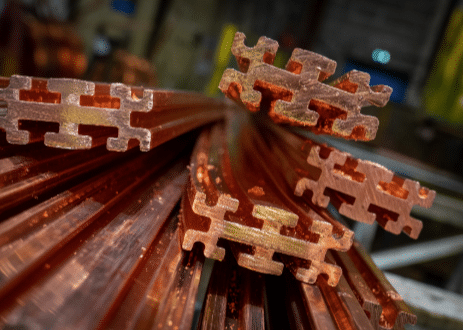
A profile is an extruded or drawn shape whose cross-section is specifically designed to meet the requirements of a given application. Unlike a standard round, square, or rectangular bar—which must then be machined to achieve the desired shape—the profile emerges from the die with the exact geometry required by the specifications.
By using copper only where it is functionally necessary, a well-designed profile can reduce the copper mass per part by 15 to 40 percent compared to a standard machined bar. On a mass-production scale, the savings are substantial and directly correlated with the LME price.
Less machining also means less machine time, less energy consumption, less labor—and fewer copper chips to recycle. The profile brings the raw shape closer to the final shape, a process known as “near-net-shape manufacturing.” Furthermore, the dimensional consistency of an extruded or drawn profile is very high, which reduces scrap and improves control over downstream assembly processes. Finally, a part that integrates multiple functions into a single extruded shape can sometimes replace several separate components, simplifying inventory, procurement, and assembly.
Industrial Applications of Copper Profiles
Copper and copper alloy profiles are used in many industrial sectors. In power distribution, they are used to manufacture busbars, connectors, and current feed-throughs. In electric mobility, they are used in the manufacture of collectors, rings, sliding contacts, and coolers. The manufacturing industry uses them for guides, slides, contact elements, and structural parts. Heat exchangers benefit from profiles with integrated fins, while connectors and power electronics rely on complex shapes for pins, contacts, and terminals.
In all of these sectors, switching from a standard machined bar to a custom-designed profile offers an opportunity for significant, immediate, and sustainable cost savings.
Recycling: Making the Most of Scraps Instead of Just Dealing With Them
The design-to-cost approach does not end with the design of the part. It also takes into account the material’s life cycle, particularly the reuse of copper scraps and offcuts.
Copper is one of the few materials that can be recycled indefinitely without losing any of its properties. Recycled copper has the same physical and electrical properties as virgin copper, but with a much smaller carbon footprint.
In a design-to-cost approach, every kilogram of scrap that is not generated is a kilogram of copper that has been paid for and utilized in the finished product. And every unavoidable scrap must be tracked, sorted, and resold under the best possible conditions to recover its residual value. This requires rigorous traceability of scrap by part number and alloy, avoiding the mixing of alloys—which reduces their resale value—and partnering with an integrated player capable of optimally closing this cycle.
The Gindre Group’s vertical integration—from casting to processing to distribution—allows us to guarantee our customers full traceability and maximum value for their copper scrap by directly reincorporating it into our own processes.
Engineering for Economic Performance
The combination of design-to-cost and profile development cannot work without close collaboration between the customer’s technical teams and the supplier’s material experts. Too often, the material supplier is consulted only during the purchasing phase, once the specifications have been finalized. At that point, there is little room for flexibility: the shape, alloy, tolerance, and cross-section have already been defined. The only remaining variable is price, and the discussion boils down to a price negotiation.
When our technical teams participate in design reviews as early as the product development phases, they can identify opportunities to reduce cross-sectional area or weight, propose higher-performance alloys that enable lighter geometries, collaboratively design the optimal profile for the intended application, validate industrial feasibility, and anticipate supply and lead-time constraints from the outset.
This early-stage collaboration is an investment that pays for itself very quickly, starting with the very first production runs.
Gindre: Expert in Copper Profiles and Design-to-Cost Approaches
For more than 200 years, Gindre has controlled the entire copper value chain, from smelting to distribution. This unique vertical integration gives us a rare capability: the ability to design, develop, and manufacture custom copper profiles in close collaboration with our customers, while simultaneously optimizing technical performance, material costs, and our environmental footprint.
Our design-to-cost support includes analyzing your existing components to identify opportunities for material reduction, the joint development of custom profiles—from die design to the validation of the first samples, advice on material composition and shape to balance lightweight design with performance, the reuse of your scrap in line with a circular economy approach, and cost monitoring that factors in LME price volatility as part of a controlled total cost strategy.
Whether you’re in the process of developing a new product or looking to optimize existing products, our technical teams are here to help you analyze your situation and work with you to develop the most effective solution.
Conclusion: In a world where copper is expensive, every gram counts
When 80% of the cost of a copper component depends on a financial market beyond your control, the only sustainable solution is to reduce the amount of material used while maintaining technical performance. This is exactly what the design-to-cost approach enables—applied from the design phase onward and supported by the development of tailored profiles.
This isn't just a minor improvement—it's a structural transformation of your competitiveness.
Gindre is ready to support you in this process. Contact our teams to schedule an initial analysis of your components and work with us to identify the most relevant optimization strategies for your business.
